Hidden spacecraft specs, micrometeorite hunting, and Martha & the Vandellas☄️
Featuring a live chat with the Artemis window maker McDanel Materials
Who makes the Artemis II windows?
The windows for the Artemis II spacecraft are made by McDanel Advanced Materials, which produces all the window panes for Orion.These windows are designed to withstand the extreme conditions of space. payloadspace.com Wikipedia
I Couldn’t find the window specs online so let’s have some fun and call McDanel Materials to see if we can get the specs from the source! Live call on 5.01.2026 with voices modified.
👉She wants to know if a guy named Proton Magic wants to “purchase a window?” I barely held back bursting into laughter at this lady. Basically they don’t have public info on their HP and the receptionist just says, “do a google search”, and that she is, “not comfortable answering these questions but you can send us an e-mail.” I was just about to ask her out for dinner when she rudely hung up on me. Her loss of course.
Wouldn’t a company making history with reentry-brave windows be proud as a pussy cat with her litter to show off the specs on a bursting top page and all over the net?

I should write to them? Well of course I’ve already written to them at two of their e-mail addresses with no reply.
------- Forwarded Message -------
From: Proton Magic
Sent: April 26, 2026. Sunday, 12:47am
Subject: Artemis II windows
To: macsales@mcdanelmaterials.comHello I read your HP about glass and windows. I would like to read about the make and specs of the windows use on the Artemis II spacecraft: materials, thickness, structure, max tolerated wind pressure, temperature etc. Do you have a page or pdf file for that? Thank you.
Search engines and their AI are also dumbfounded about the window specs. AI even changes the topic to sightseeing out the windows after failing to find any specs.

👉I did find this Artemis hardware NASA testing document. It looks all official and talks about testing that was done but doesn’t mention windows, doesn’t say what tests were done, doesn’t give any specs or test results nor lead to references or links with this information for any type of hardware. Image linked to 2-page doc.

On May 1st I sent an e-mail to the lead author Trevor Graff, Chief Scientist in the Astromaterials Research and Exploration Science (ARES) Division at NASA. No reply yet…
Here you can see the window maker McDanel Material’s HP. There’s no page on the Artemis windows specs, a furnace test photo image (of what exactly?) is about as close as one can get to real information.


The Sight Windows link at the bottom doesn’t lead to anything about aerospace.
So much for the manufacturing and testing of the Artemis aerospace windows. Let’s go out in the field and see the performance of these masterpieces.
First look at this beautiful shiny reentry capsule. So where are the reentry burns from the 5,000 degrees F? Underwater maybe?

Good views of the capsule in the water starts around 2:00:30
Americans in deep debt should be proud of the great work their country does.
Eventually the Navy got to it and now it’s a bit discolored, even around the windows.

For Artemis I, the capsule got moved indoors where we can clearly see the capsule looking blackish with places of discoloration from top to bottom, suggesting the window areas were also exposed to damaging heat.

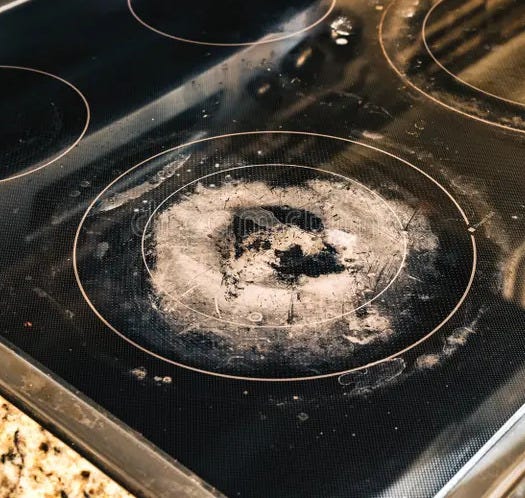
For comparison, the maximum temperature of an electric burner can reach up to 750 degrees Fahrenheit vs. the 5,000 at reentry. A burnt stove is no pretty site.
Which capsule is even the real one? NASA asset, I mean conspiracy debunker, Dave McKeegan shows us in the below vid @16:45 a “real” capsule on the left and an “AI rendered” capsule on the right. I just want to point out that real or fake renditions made by various parties could be interchangeable at the spin of a dime and we would not be the wiser for it.

About Dave, he finds, or more likely works with, some silly conspiracists who promote minor issues he easily debunks and comes out looking smart. This is the, “funny man/straight man” propaganda trick. But I digress…
If we ask DuckDuckGo the specs of the windows this is what we get:
The windows of the Orion spacecraft used in Artemis II are designed to withstand extreme conditions in space, featuring multiple layers thick to absorb micrometeoroid impacts and inhibit bacteria and mold growth. They are built to meet strict mass requirements while ensuring safety for the astronauts during their mission. payloadspace.com European Space Agency
👉I’m sorry but WTF does bacteria and mold have to do with windows in the vacuum of frigid space or in the fireball heat of reentry? And “micrometeoroids”? What is the importance of these micros if you will fry to small bits yourself on going thru the radiation belts or on reentry? It’s a diversion from the radiation belts and reentry fry-ups to the small but workable issues of germs and micrometeroids.
For fun, I wondered how do they find micrometeorids, and determine their size and speeds? From experiments on satellites in 1960s that’s how.
A satellite counts a meteor every time there is a radar echo from the meteor trail. First, one has to relate the electron density of a meteor trail to the strength of the received echo. Considering our present poor knowledge of ionization probability, there is substantial uncertainty in this value of limiting mass.

Probably because of the uncertainty in satellite observations, micrometeorids are now collected in areas where there is no terrestrial sedimentation, typically polar regions. Ice is collected and then melted and filtered so the micrometeorites can be extracted under a microscope.
Even more wild, DuckDuck Go AI says:
Micrometeorites are typically found by collecting material from locations like rooftops, gutters, or remote areas. They are then studied using sieving to isolate the particles and microscopy to identify their composition and origins [like from what planet?]. Wikipedia Science Friday
👉Introducing the, “Micrometeorite Man”, Jon Larsen
At least the intro to the story honestly tells you they just make things up:
Larsen began his quest for urban micrometeorites in 2010 after one landed on his porch table while he was eating breakfast.
Are they trying to make us believe that the moon landings must be true if breakfast table landings are true?

Isn’t Jon more likely to find hardened camel shit than a meteor, not to mention that there are zillions of small rocks in the sand here? Why isn’t Jon looking for rocks ON TOP OF THE SNOW in his home country Norway? As I said, micrometeorites are a diversion and this PR stunt in front of camels proves it. (Note: I’m mixing the words….roids with ….rites depending on the source and my preference).
👉Another thing that spacecraft windows can tell us is to look inside of one of Bezos’ space capsules like this one. Do you see all the complex machinery thru those big picture windows? Should have life support stuff, 02 tanks, controls, computers, communications, sensors etc.

☞Right, there is almost nothing inside the craft except what looks like a dentist’s chair that Bezos must have picked up on Craig’s list. You can scroll down and browse other Blue Origin capsule photos here and see the empty space in these “spacecraft” and what must also be empty space inside the fake astronuts’ heads.
I also looked thru this 526 page Apollo Summary Report. Don’t mind the infinity symbol going around a pyramid in the logo.


Your post has made my day Proton. The Artemis craft is obviously built from the repurposed materials unearthed by the rocket scientists/researchers/actors at Skinwalker Ranch. So it goes without saying..TOP secret stuff.
I must say that the delayed muscle atrophy of the female actornaut takes the cake..almost as dramatic as the reaction of her Nasa medical personnel that were “spotting” her as she was relearning how to walk three days later 🤦♂️. The performance by all were worthy of a role in a Mexican daytime tv drama. All the nasa social media posts disappeared after that beauty!
We really live without aaaaannnnnyyy doubt what so ever in a clown world.